Everyone knows how important ventilation is, and most people understand how critical it is that we use ventilation when required. Sometimes it’s just not enough.
The key areas in a home that need sufficient ventilation are:
- Bathroom
- Toilet and
- Kitchen
In this article, we are primarily talking about bathroom and toilet ventilation. Sometimes, using ventilation isn’t quite enough, because of design issues or how we may be using the ventilation system that you have.
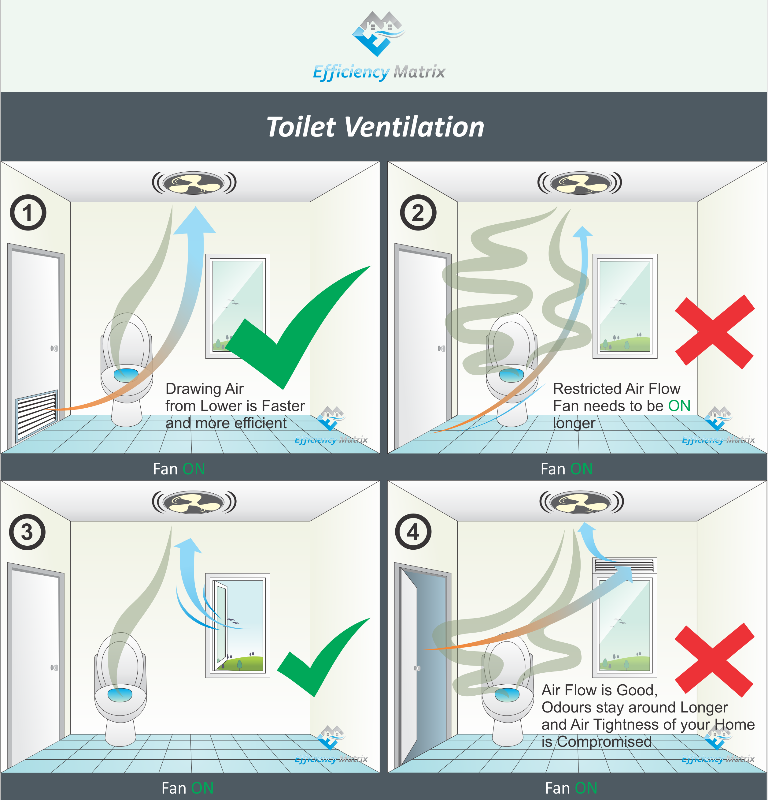 The first thing, and probably the most important aspect, that can help the effectiveness of ventilation with minimal investment, is to ensure that the fan installed has a readily available source of air to move. Usually, doors are closed when ventilation is needed. Bathrooms and toilets are usually small rooms. The amount of leaks in a standard bathroom at the bottom of the door or through cracks is not nearly large enough an opening, to allow air in, so a reduction in fan performance can be up to 30%-40%.
Diagram 2 illustrates how an air tight bathroom/toilet, hampers the performance of ventilation.
Tests undertaken by Efficiency Matrix in a toilet found that an extraction fan operating with a door open moved 78 l/s compared to 45 l/s with the door closed.
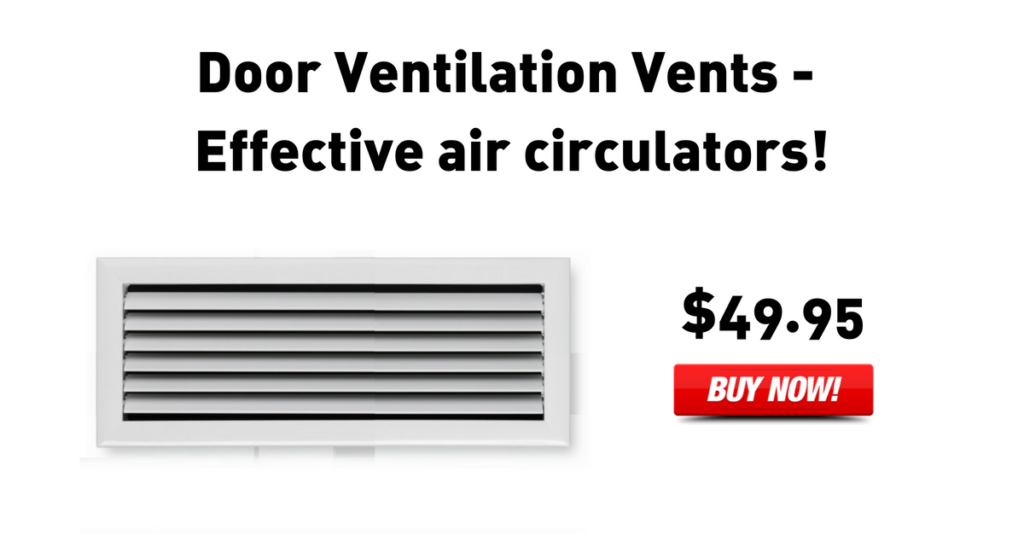
The one sure way to fix this, is to install a door grill in your bathroom/toilet door, so that whenever a ventilation fan is turned on with the door closed, it can leverage from air leaks throughout the whole building in order to draw enough air with minimal strain straight to the extraction fan.Installing a door grill available from Efficiency Matrix, enabled the fan to move 75l/s.
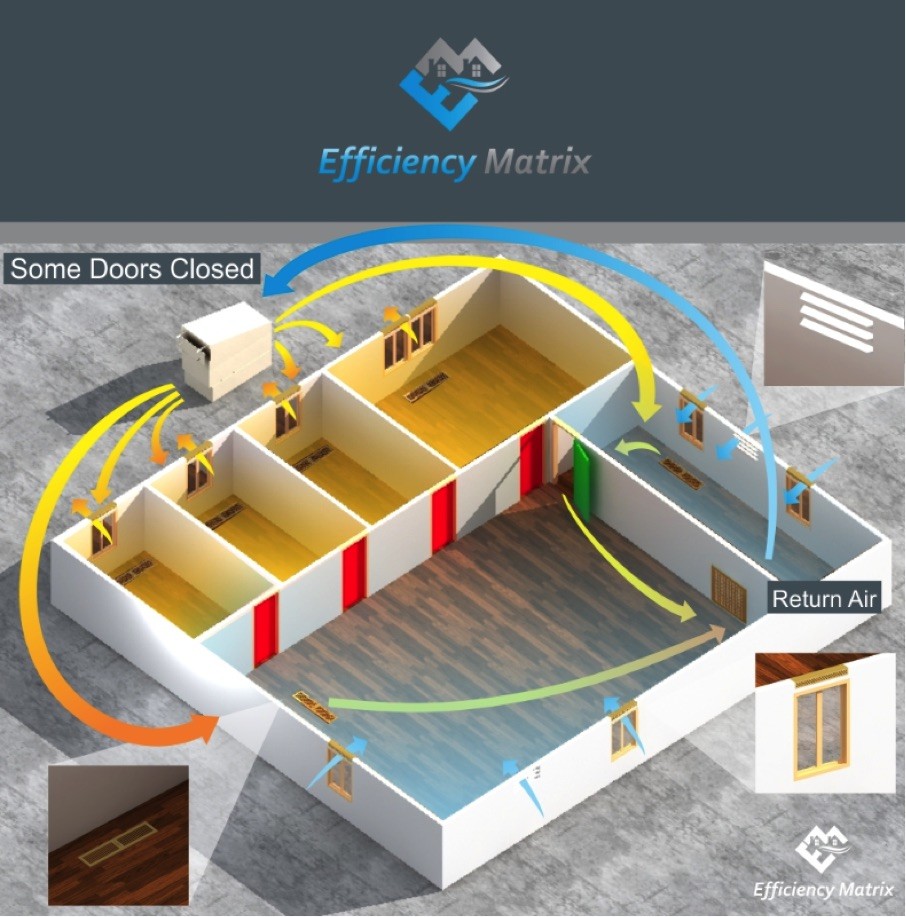
Strategic positioning of a supply source should also be looked at ensuring the emission source is in between the extraction point and the air supply point.
There is a significant difference between Diagram’s 1 and 3 , Diagram 1 will produce the best outcome.
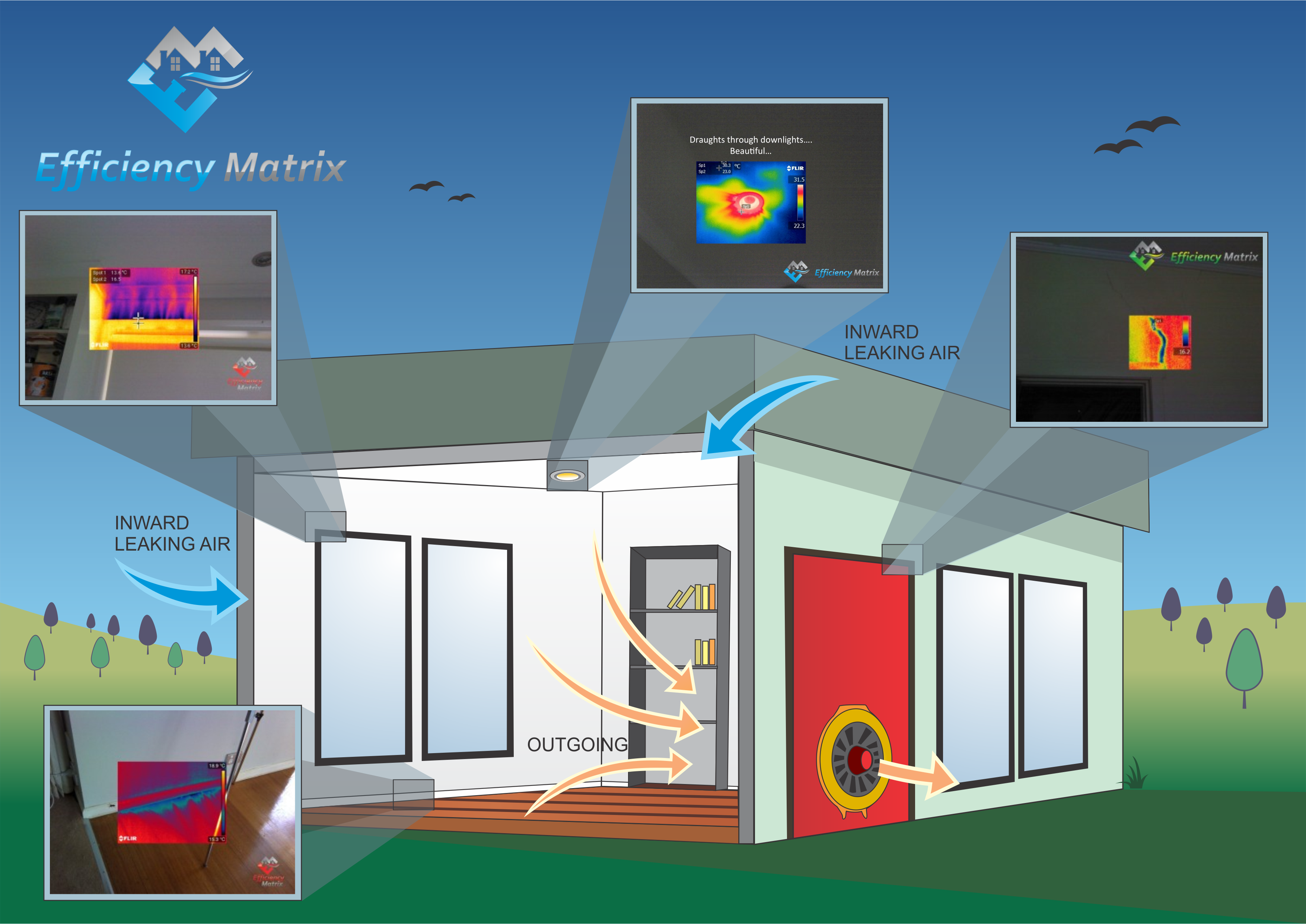
Draught stoppers are also a great idea, because it ensures your bathroom in particular, can maintain a warmer temperature in winter, due to less air leakage, which in turn sets the dew point temperature gap larger reducing the chances of mould taking hold.
Diagram 4 shows how an over ventilated bathroom is not effective enough, and is especially problematic for humidity and mould control.